

We Have the Enemy's Playbook: What Jesus's Temptation Teaches Us About Standing Firm

I'm a millennial, so when I don't know how to do something, I go to YouTube. There is a tutorial video for almost anything you could ever need to know. I am forever in debt to those folks who simply record the process and give viewers step-by-step instructions on how to complete the task successfully.
In Ephesians 6, Paul gives the church a mission: stand. Stand firm against the unseen powers attacking our hearts, minds, souls, and communities. Wouldn't it be great if we had someone to look at, an example to follow, a tutorial for how to stand firm against Satan and his schemes?
You probably know where I'm going with this:
For we do not have a high priest who is unable to sympathize with our weaknesses, but one who has been tempted in every way as we are, yet without sin. (Hebrews 4:15)
Sometimes we forget that Jesus was fully human. He was made just like us. He had wants, needs, and desires. He felt the full range of human emotion. He got hangry. Jesus even went through a specific season of testing in the wilderness. Satan came at what appeared to be his most vulnerable moment, his weakest point physically, his most isolated time. Christ was tempted to give in to his desires, to prove himself, to find a shortcut to winning the approval of men.
Where all of us have sinned and fall short (Romans 3:23), Christ stood firm. How did he do it? Let's watch.
The Setup: Forty Days That Changed Everything
The temptations of Christ (Matthew 4:1-11) come immediately after his baptism in the Jordan River. The heavens opened, the dove descended, and the voice of God affirmed, "This is my beloved Son, with whom I am well-pleased." It's an incredible mountain-top moment. But Jesus doesn't immediately launch into public ministry.
Then Jesus was led up by the Spirit into the wilderness to be tempted by the devil. After he had fasted forty days and forty nights, he was hungry. (Matthew 4:1-2)
Let's not downplay the importance of spiritual practices in overcoming the schemes of the devil. Solitude, fasting, and prayer are critical disciplines for spiritual growth. Satan had a fundamental misunderstanding here. He thought he was attacking Jesus at his most vulnerable, when Jesus was actually most in tune with God the Father. Satan attacks in loneliness and weakness. The wilderness was neither, not really.
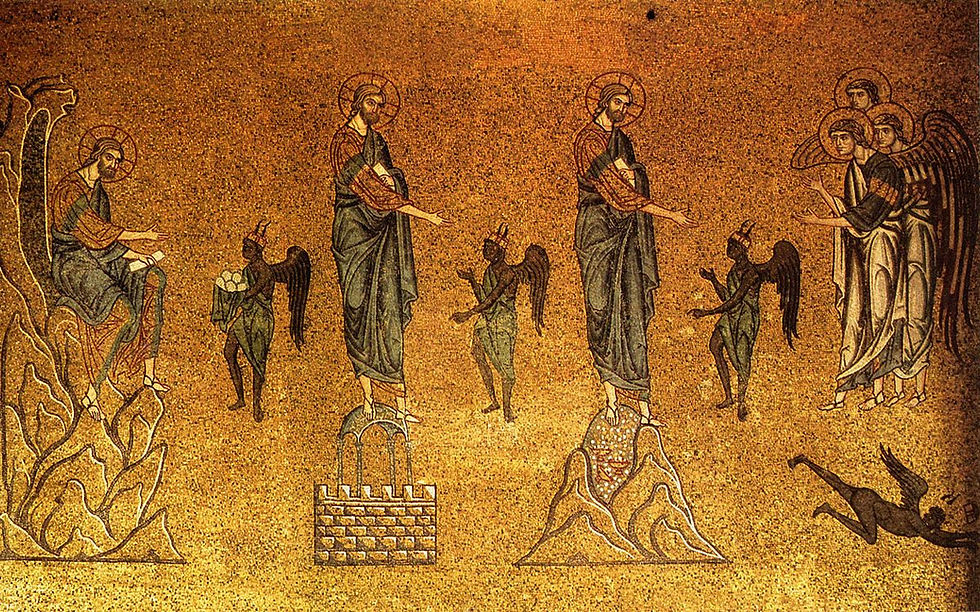
Temptation #1: Give In to Your Cravings
"If you are the Son of God, tell these stones to become bread." He answered, "It is written: Man must not live on bread alone but on every word that comes from the mouth of God." (Matthew 4:3-4)
A few things worth noting here. First, Jesus was fasting for a purpose. When we commit to spiritual growth, Satan often shows up to add resistance. If your commitment is to fasting, food becomes the temptation. If your commitment is to Bible reading, the phone becomes the temptation. If you've committed to consistent worship with other believers, sleep becomes the temptation. Satan can use good things in bad ways to derail our spiritual growth. Expect it. Resist it.
Second, notice that Satan was attacking Jesus's very identity: "If you are the Son of God..." It's literally the oldest trick in the book. Back in Genesis 3:1, he started with Eve the exact same way: "Did God really say...?" When doubt creeps in about who God says you are, you can bet the enemy is nearby.
This temptation falls under what 1 John 2:16 calls "the lust of the flesh." God gave us natural cravings for good things – food, drink, comfort, rest. But when we are feeling weak or deprived, Satan swoops in and distorts those good desires in ways meant to draw us away from our right relationship with God.
Jesus responds by wielding the sword of the Spirit. Just as Paul instructs in Ephesians 6, Jesus's offensive weapon against the deceiver is the word of God. He quotes Deuteronomy 8:3. Not from memory he had to strain for, but from a life saturated with Scripture.
Temptation #2: Make a Spectacle of Yourself
Then the devil took him to the holy city, had him stand on the pinnacle of the temple, and said to him,"If you are the Son of God, throw yourself down. For it is written: He will give his angels orders concerning you and they will support you with their hands so that you will not strike your foot against a stone.” Jesus told him, "It is also written: Do not test the Lord your God." (Matthew 4:6-7)
Yes, the devil knows the Bible. One of his favorite tricks is twisting Scripture to make it say whatever he wants. All it takes is a little misquote, a slight distortion, or an out-of-context passage, and suddenly people are being led away from the very Savior the Scriptures point to. Context always matters.
But notice what Satan is actually offering here: spectacle, crowds, gasps, headlines. "If you are who you claim to be, then flaunt it!" This is the temptation of pride, what 1 John 2:16 calls "the pride of life."
Jesus's mission was not to become famous. He came to inaugurate the eternal kingdom of God, which he compared to a mustard seed, a bit of leaven in bread, a treasure hidden in a field. Small, quiet, subversive, powerful.
Satan tempted Jesus to take what God had already given him. God had already affirmed his identity at the baptism. He didn't need to prove it to himself or anyone else. The same is true for us. When you are tempted to inflate your accomplishments, chase titles, or live for the approval of others, remember: God is the source of all good things. He has already seated you with Christ in the heavens. You are his masterpiece. You don't have anything to prove to anyone.
Temptation #3: Take a Shortcut to the Prize
"Again, the devil took him to a very high mountain and showed him all the kingdoms of the world and their splendor. 'I will give you all these things if you will fall down and worship me.' Then Jesus told him, 'Go away, Satan! For it is written: Worship the Lord your God, and serve only him.'" (Matthew 4:8-10)
Power. Money. Fame. Authority beyond belief. All the kingdoms of the world can be yours, if the price is right.
Notice that Satan doesn't just tell Jesus about the kingdoms, he shows them. Before his own eyes, Jesus saw all the world had to offer. He saw a shortcut to his mission, his goal, his entire purpose for coming to earth. He could have it all without the cross. All he had to do was worship Satan.
This is the temptation 1 John calls "the lust of the eyes." Our eyes are directly tied to our desires. The average American sees somewhere between 3,000 and 5,000 advertisements every single day. Advertisers know exactly what they are doing when they put something in front of your eyes. And so does Satan.
Once again, the temptation was to take for himself what was already guaranteed by God, but at the cost of giving to Satan what only belongs to God. And once again, Jesus counters it with Scripture, quoting from Deuteronomy 6, the same chapter that instructs Israel to write these commands on their hearts and bind them on their arms. Keep the word of God close. Saturate your life with it so it flows through you and from you.
We Have the Playbook
Now that we have studied the enemy's attack pattern, we know he can be defeated.
He attacks your flesh, your cravings, your appetites.
He attacks your pride, your identity, your need for approval.
He attacks through your eyes, your desires, your willingness to take shortcuts.
And in every case, Jesus met him with the word of God.
We are given this promise in 1 Corinthians 10:13:
No temptation has come upon you except what is common to humanity. But God is faithful; he will not allow you to be tempted beyond what you are able, but with the temptation he will also provide the way out so that you may be able to bear it.
There is always a way out. There is a Scripture you can bring to mind. There is a power-off button. There is the option to say no. Your struggle is not unique to you, no matter how alone you feel. Sometimes what we need is to break out of our habits and normal patterns. Instead of isolating, we engage with community. Instead of retreating, we confront the attack head on.
Within the armor of God described in Ephesians 6, there is nothing to protect our backs. We are not expected to retreat. We are commanded to stand.
Where Adam and Eve faltered, Jesus stood firm. Because he did, we can too. And when we fail, not if, but when, there is forgiveness, mercy, and grace. Look to Christ. Watch how he did it and learn from him.
We have the enemy's playbook. No YouTube required.


Comments