

A Matter of Time

I have a riddle for you, straight from Tolkien's "The Hobbit," the chapter called Riddles in the Dark. It's the last one Gollum poses to Bilbo:
This thing all things devours: birds, beasts, trees, flowers. Gnaws iron, bites steel, grinds hard stones to meal. Slays kings, ruins towns, and beats high mountains down.

You probably already shouted the answer: time.
We're continuing our series in Ecclesiastes, and Ecclesiastes 3 is the great time poem of Scripture, the one that inspired The Byrds' 1965 hit "Turn! Turn! Turn!" Word for word, the lyrics come from Ecclesiastes 3:1-8. It's wild to think a pop song from the sixties is just the Preacher's poetry set to a beat.
Two Kinds of Time
Quick recap of where we've been. Ecclesiastes is narrated by a figure called Qoheleth, literally "teacher" or "one who gathers." Some think this is Solomon, others think it's a Solomon-like caricature. Either way, he's asking a massive question: what does a person gain from all their labor under the sun? Is anything not hevel, that Hebrew word for smoke or vapor, something here one moment and gone the next?
Which brings us to time. Augustine wrestled with the same question we all do: "What is time then? If nobody asks me, I know, but if I were desirous to explain it to one that should ask me, plainly I do not know."

Hebrew and Greek both have two separate words for time. The first is chronological, fixed, scheduled. Think clock time, calendar time, the time you feel like you control. My family lives and dies by our shared calendar. If it's not on the whiteboard, it doesn't exist, and someone's getting an earful about it.
The second word is more like season or occasion, the right moment for something to happen. When's the best time to plant your crops? You can't give a date. You pay attention and act when the moment is right. Should you take the new job or stay put? That's not a schedule, that's a season, and you discern it by paying attention rather than by controlling it.
Here's the uncomfortable truth: we think we control our time, but we don't. We've gotten more productive than any generation before us, and yet we all feel more overworked than ever. More efficiency just means more work fills the space. The gains don't stick.
Time Belongs to God
All physical creation is bound by time. Where there's matter, there's time, which is why Einstein could talk about spacetime as one fabric. But God isn't bound by it. He created time, so he stands outside of it. Peter tells us a day is like a thousand years to the Lord, and a thousand years like a day. Our lives are a blink to him, and yet every single moment carries the weight of eternity, because it has never happened before and it never will happen again.
Pastor and author Bobby Jamieson puts it starkly in his book "Everything Is Never Enough":
Given enough time, time will take back all it gives. Given enough line, time will reel back all it cast your way. Every blessing time brings will eventually make way for a burden. Time runs in only one direction, but it gives and takes equally. All its gifts are loans...Every action will sometime meet its equal and opposite. Once time finishes you, your final balance will perfectly match the zero you started with.
Look at how the Preacher lays out his famous list in verses 2-8. It's couplet after couplet, mostly opposites: a time to be born, a time to die, a time to plant, a time to uproot, a time to weep, a time to laugh. It reads almost like a spreadsheet of your life, assets and liabilities, gains and losses. And the bottom line always equals zero. Time is one of the great equalizers.
Beautiful in Its Time
So what's the point of all our striving? Verse 11 answers with one of the most powerful lines in the whole book: "He has made everything appropriate in its time. He has also put eternity in the hearts of men, but no one can discover the work God has done from beginning to end."
Everything is beautiful in its time when it's God's timing, not ours. And he's placed eternity itself inside every human heart, which is why every culture, in every era, on every continent, has practiced some form of religion. We are wired to reach past the visible for the divine. Archaeologists used to believe agriculture came first and religion followed as civilizations formed around farming. Then a dig in modern-day Turkey uncovered the oldest known city, built around a temple complex, predating agriculture by thousands of years. Worship came first. God wired eternity into us from the start.
But we don't get to see the whole picture while we're living it. I think of Rembrandt's tapestry design of the Commissioning of Peter, made for the Sistine Chapel. Zoom in and you see a small, ordinary family scene: a mother with a basket, a father with a fishing pole, a child, a dog trailing behind.

Zoom out and that little family is a tiny thread in a massive, breathtaking whole. That's your life. You get one small patch of the tapestry, and you don't get to see how it fits into everything else while you're living in it.
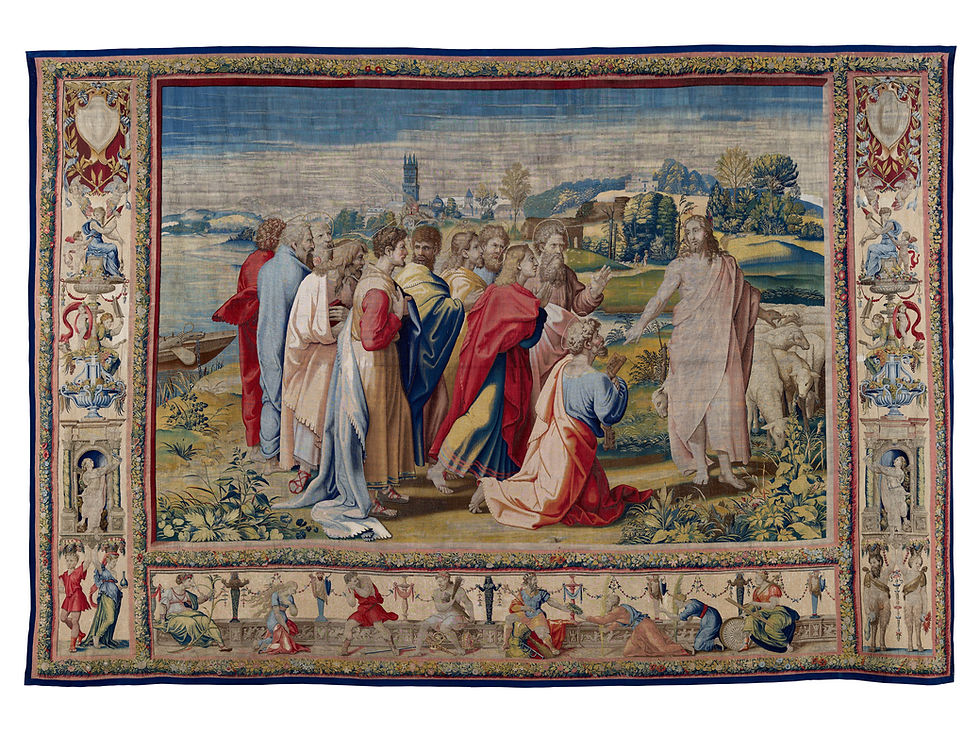
Only afterward, only when God pulls back the curtain, do we see the whole design.
Where Is Justice?
The Preacher takes a hard turn in verses 16-21. He observes wickedness sitting right where justice should be. Courts corrupted. The powerful buying verdicts while the innocent suffer. He notes that humans and animals share the same breath, the same fate of dust to dust, and wonders what really separates us if our systems of justice can be bought.
Here's where belief and observation pull against each other. He observes corruption is rampant and justice is often withheld. But he believes God will judge the righteous and the wicked in his own time. He observes that humans die just like animals do. But he believes, he hopes, that something better waits for God's children beyond the grave. Sometimes what we see and what we believe don't match up neatly, and Scripture doesn't pretend otherwise.
Seize the Day
This is where the Preacher lands, in what scholars call his carpe diem passages. "I know there's nothing better for people than to rejoice and enjoy the good life. This is a gift from God." A date night with your spouse, friends over for dinner, collapsing into your recliner after a long day: these are gifts, not distractions from real life. They are real life.
Think of the scene from "Dead Poets Society," where Robin Williams' character leans in close to his students and whispers, "Carpe diem. Seize the day, boys. Make your lives extraordinary."
Or Gandalf's line to Frodo: "All we have to decide is what to do with the time that is given to us."

Jesus had roughly three and a half years of public ministry, and he changed the course of human history without ever seeming rushed or too busy for anyone in front of him. He said it plainly in John 9: "We must do the works of him who sent me while it is day. Night is coming when no one can work."
So walk in the light while you have it. Encourage someone today while it's still called today, because Hebrews 3 warns us not to let our hearts get hardened. And Paul reminds us in Ephesians 5 to make the most of every opportunity because the days are evil.
Redeem the time. It's the only kind you'll ever get.
1. When in your life have you tried to force a "chronos" moment (a scheduled, controlled time) that really needed to be a "kairos" moment (a season you had to wait for and discern)? What happened?
2. The sermon says productivity gains never actually give us more free time, they just get swallowed by more work. Where do you see that playing out in your own life right now?
3. If you could zoom out and see your life as a small patch in a much bigger tapestry, like the Rembrandt image, what's one season you're currently in that's hard to make sense of up close?
4. Where do you see the gap between what you observe (corruption, injustice, suffering) and what you believe (that God is just and will set things right)? How do you hold both at once without letting one cancel out the other?
5. Whose name came to mind while you were reading or listening to this? What's one way you could "seize the day" and reach out to them this week?
LISTEN TO or WATCH the full sermon at tulipstreet.com/sermons


Comments