

Teenage Boys with Weed Eaters: What "Under the Sun" Really Means

Have you ever been handed a job, given all the right supplies, and still had no idea what you were doing?
When I was in middle school and high school, I attended a private Christian school in Tennessee. Every summer, the school offered "work study" hours for students, matching them with various jobs around campus. Some worked in the preschool or elementary daycare. Others stayed inside to clean offices or file papers.
My job was mostly outside. We ran weed eaters, cleared the parking lots with leaf blowers, painted the iron fences, and so on. Needless to say, we weren't always giving it our best effort. When the supervisors weren't around, I can't speak for the quality, or the quantity, of our "work."

Can you imagine handing a group of 13- to 15-year-olds a set of weed eaters and then walking away? If you later found us joyriding around campus in the school's ancient work trucks, that one's on you.
Left to our own devices, without oversight or clear direction, we humans tend to make a mess of things. As we get older, we start to realize that no one really knows what they're doing. We're all making it up as we go. Most of us are trying our best. Many of us feel like impostors in our own careers. And whether someone succeeds or fails, no one fully understands why.
Society, in a lot of ways, is just a bunch of teenage boys with weed eaters. Not literally, but you get the point.
What Does "Under the Sun" Even Mean?
The Teacher in Ecclesiastes is wrestling with all of this. Why do so many people feel aimless? Does anybody really know what we're supposed to be doing? Is there anything that truly lasts? Will I ever stop feeling like I'm just pretending to be an adult?
Alongside the word hevel, there's a phrase the Teacher repeats again and again throughout the book: "under the sun." He uses it roughly 30 times, so it's worth paying attention to. What does this phrase actually mean, and how can understanding it help us make sense of the rest of the book?
1. An Earthly Perspective
The Teacher's exploration of life stays grounded in the physical realm rather than the spiritual one. His observations are limited in scope to what's mostly tangible. He does touch on time, death, and the end of all things, but he remains mostly rooted in the here and now.
He isn't taking a bird's eye view from a thousand feet up. His perspective stays at eye level. He looks around. He observes. He notices. He experiments. What is there for a person to do on this thin layer of dirt beneath the clouds, the moon, the stars, and the sun?
That's why most of the Teacher's questions aren't rhetorical or hypothetical. He's genuinely looking for answers. He isn't playing mind games or running thought experiments. Ecclesiastes is heavily rooted in real world observation. The great challenge, as we'll see throughout the book, is holding onto an eternal perspective at the same time.
2. Life in a Fallen World
Ecclesiastes often gets read as pessimistic, even bleak. But the Teacher isn't being pessimistic, he's being realistic. As much as we might want to return to a time of innocence and peace, like the Garden in Genesis 2, we live in the reality of Genesis 3. Something is broken, and it can't be fixed on our own. Our relationships with God, with each other, and with the rest of creation were shattered in the Fall. As soon as we chose to go our own way, God let us make that choice (like the teens with the weed eaters).
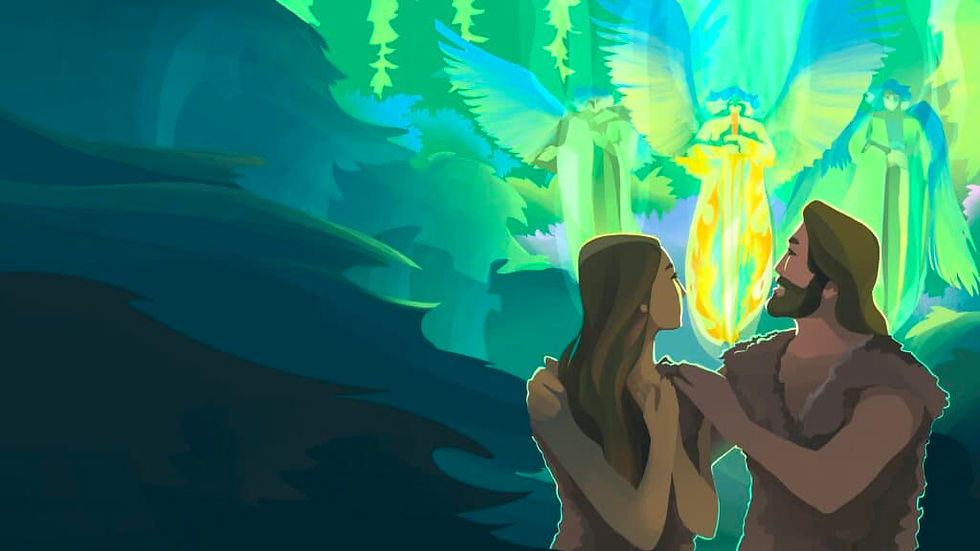
Ever since then, we've been trying to get back. But we can't. All we can do is make the best of a bad situation. We shouldn't lose hope, but we do need to be honest about the world we live in. Creation itself was "subjected to futility" (Romans 8:20) and has been fighting us ever since. Eking out a living on this planet is hard work. Relationships are hard work. Faith is hard work.
Anyone who has ever taken on a home repair or remodel knows it's never as easy as we think. It always costs twice as much and takes three times as long. That's life "under the sun."
3. The Limits of Human Reason and Effort
Every endeavor involves "known knowns," "known unknowns," "unknown unknowns," and "unknown knowns." It looks strange written out, but it's often called the Rumsfeld Matrix, and it's a useful way to think through any military operation, business venture, or family vacation. What do we know? What do we not know? What do we not even know that we don't know?
There will always be things we don't know. Human logic and reason can only take us so far. The scientific method, as world changing as it's been, has its limits too. There are things we may never know. What is dark matter and dark energy? What happens inside a black hole? What does your wife actually want for dinner?
Even though the Teacher was writing near the end of the Bronze Age, people of his day understood the world and humanity better than we often give them credit for. And what was true for him is still true for us: even with the best research, the most cutting edge technology, and the brightest minds, our collective human reason and effort will always run into limits.
4. A Universal Human Condition
Wisdom literature like this is truly universal. If you were suddenly transported back to the Bronze Age to witness the Teacher's world, plenty of it would be unrecognizable. It was a very different time. And if he could see 2,500 years into the future, he'd be utterly terrified by our metal flying birds and our magic glowing bricks that talk to us.
But humanity hasn't really changed. The Teacher's observations still resonate today, just as they have across time and space. Whether you're in late Bronze Age Israel, medieval Europe, Han Dynasty China, a tribal village in the Amazon, or an office in Silicon Valley, his words still carry weight.
We all know what it's like to feel small in a world we don't fully understand. We all know the sorrow of lost opportunities. We all know what it's like to expect fulfillment from work, possessions, power, or popularity, only to be let down once the initial excitement fades. We all struggle to find meaning, purpose, and value in a world that so often feels indifferent to us.
Any person, in any culture, in any era, could walk the same road as the Teacher and land in roughly the same place. Life under the sun is fleeting, temporary, frustrating, and ultimately leaves us empty.
5. Life Above the Sun
There are glimpses throughout the book of a better way. We don't have to resign ourselves to a hevel life under the sun. We can shift our focus to the one who is above the sun. God calls us to a different kind of existence altogether. The Teacher calls us to eat and drink with joy, because wisdom itself is a gift from God. Life apart from God is wearisome toil. Life with God creates purpose and meaning in an otherwise indifferent world.
Fast forward to Jesus. In John chapter 3, Jesus has a conversation with a man named Nicodemus, and honestly, I think the Teacher would have loved to sit in on this one. Jesus talks about the wind blowing where it wants, with no one able to control it, then calls out Nicodemus for not understanding. That's the Teacher's whole point, in a nutshell.

But then Jesus says something we often misread. Most translations say "born again," but the phrase could just as easily mean "born from above." In other words, Jesus is tracking right alongside Ecclesiastes' take on life "under the sun." He tells us the way off the treadmill, the way to find lasting meaning, purpose, and value, is to be born "from above," to live life "above the sun."
A God focused, Jesus centered, Spirit led life is one that will truly last. We are not alone in this.

Comments